A preliminary version of this work was selected for an oral presentation at AGU Fall Meeting 2025 (AGU25) and was featured as a Highlighted Talk (link).
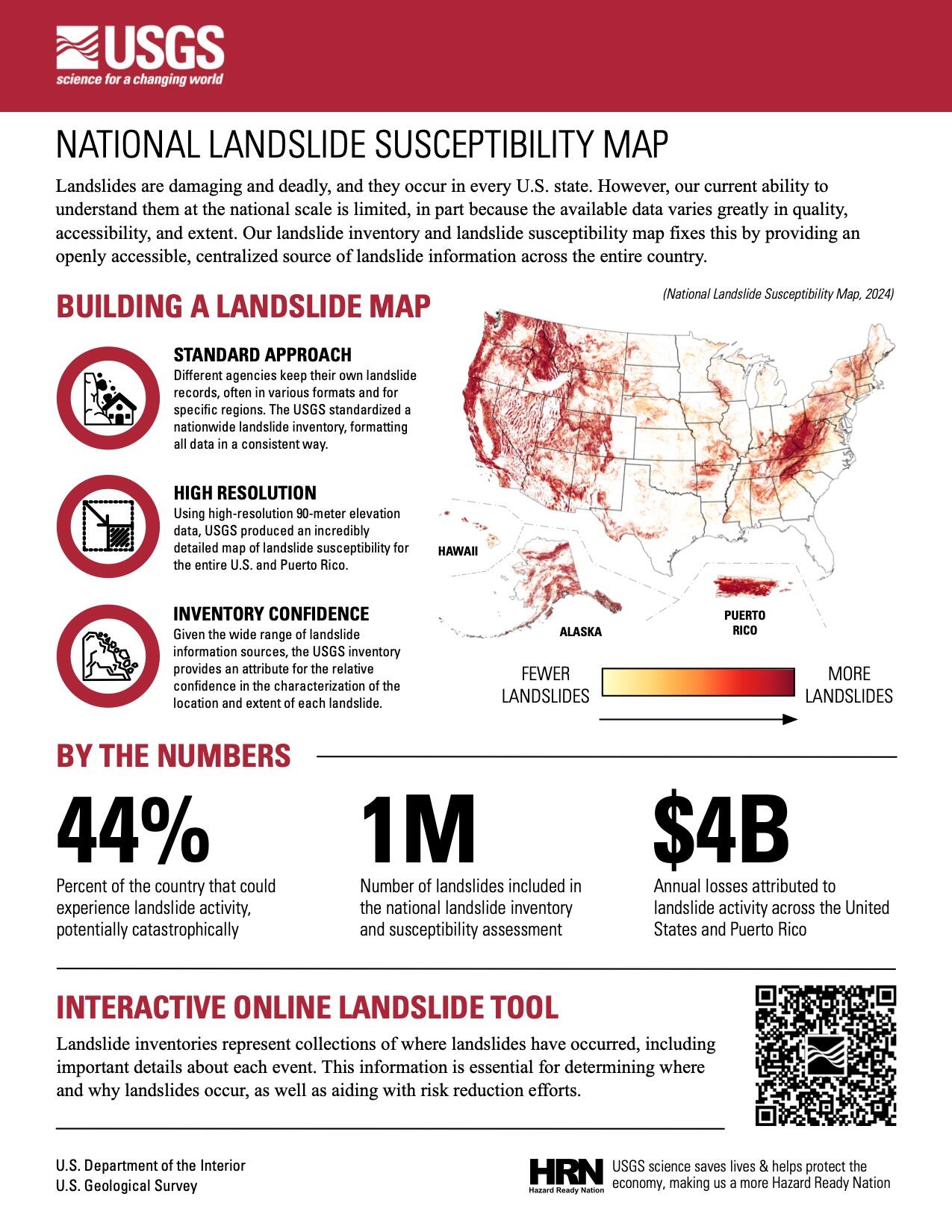
While landslides are pervasive across the U.S., their specific social, economic, and ecological impacts remain underappreciated due to their localized and episodic nature, co-occurrence with other hazards, and variability across broad regions. Efforts to systematically quantify landslide impacts have often been limited to localized case studies, carried out by numerous agencies with differing standards, and constrained to limited time frames due to labor-intensive data collection.
In this study, we leverage generative AI to develop an agentic framework, composed of a series of agents with increasingly focused tasks, capable of extracting and synthesizing diverse web sources to capture the full range of direct and indirect landslide impacts. This work builds on a national landslide damage and loss dataset that was compiled by the U.S. Geological Survey (USGS) through manual identification. While this manual approach significantly advanced national-scale understanding of landslide impacts and helped establish new guidelines for a database structure, it underscored the time-intensive nature of retroactive assessment and the limitations of adhering to readily searchable government reports and published literature.
Therefore, the agentic framework we developed provides a scalable alternative workflow by automatically performing data preprocessing (e.g., text recognition, extraction, and cleaning), identifying landslide impact records, merging complementary records, detecting time-evolving records, and flagging conflicting records for expert review. This framework synthesizes sources from both traditional repositories (e.g., government reports) and more dispersed sources (e.g., news articles, non-governmental organization reports).
Preliminary findings demonstrate how the framework captures direct losses, such as the number of fatalities, injuries, or damages, which are expected but have not been consistently quantified. Additionally, underappreciated indirect landslide consequences have been discovered, such as environmental degradation, public health concerns, and legal actions. Overall, this study presents a framework for leveraging generative AI to better capture the full range of consequences of landslides, and potentially other natural hazards.
Core team members
Project partners/funders

Send us an email sloos [at] umich [dot] edu
We are looking for new team members and partners!
Office Address: GG Brown, 2350 Hayward St, Ann Arbor, MI 48109