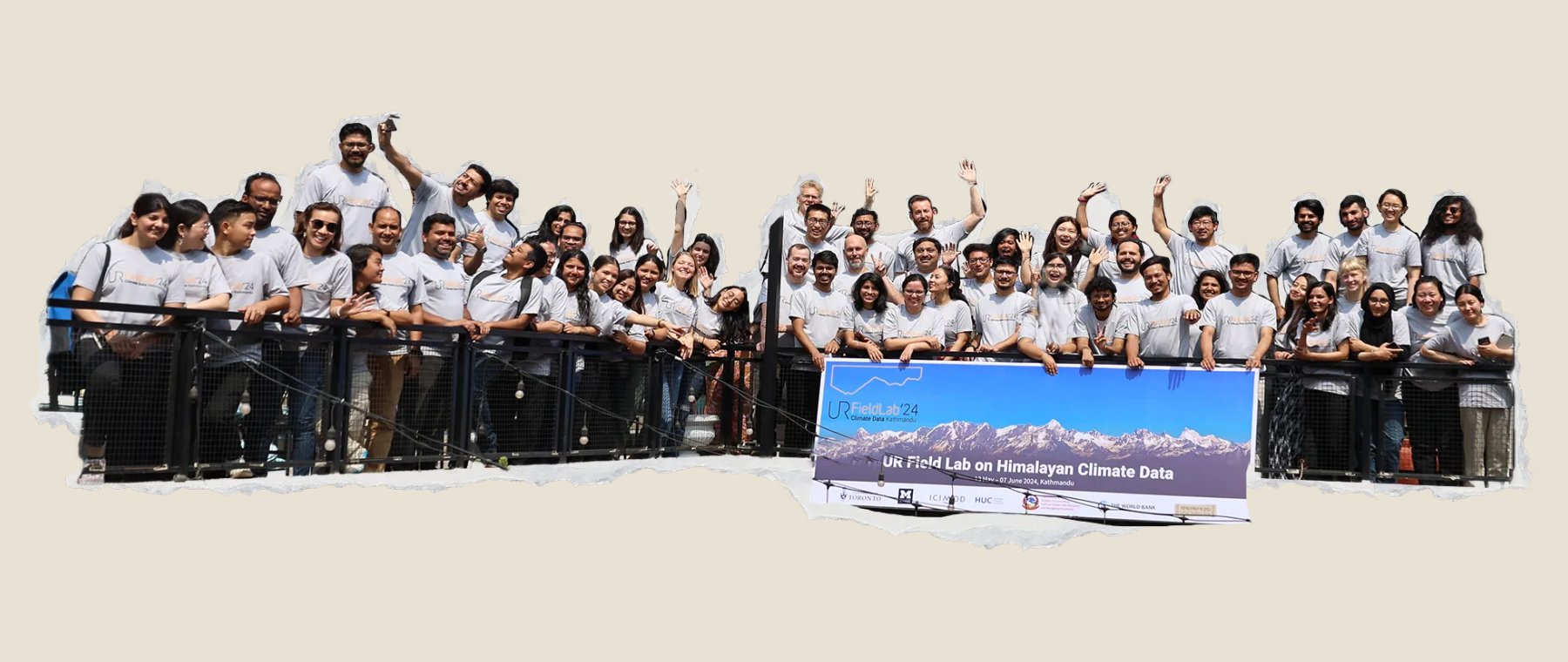
Participants of the UR Field Lab on Himalayan Climate Data, Kathmandu, 2024 (photo: urfieldlab.com)
The Understanding Risk (UR) Field Labs are collaborative, unstructured un-conferences that bring people together to produce creative approaches to today’s most pressing climate and disaster risk management issues. The UR Field Lab on Himalayan Climate Data (Kathmandu, 13 May – 7 June 2024) gathered roughly 80 scholars, practitioners, activists, artists, community leaders, and storytellers from over 19 countries to examine how climate data and information infrastructures shape adaptation and mitigation in the Himalayan region.
Over four weeks, participants co-designed the schedule and formed working groups to develop projects ranging from art to research—new analytic tools, maps, sensing technologies, data protocols, artistic pieces, and communication products—with the aim of creating a more equitable and pluralistic data landscape in the region.
Themes
Themes that Field Lab activities focused on included:
- User Needs for Climate Change Information
- Local and Indigenous Knowledge
- Climate & Disaster Risk Management
- Sensing and Sensors
- Urban Climate Challenges
- Local Energy Transitions
- Public Health and Climate Change
- Displacement, Migration, and Mobility
- Biodiversity & Ecological Change
- AI and Machine Learning
- Making with Data: Art, Design, Media
Outputs
Outputs from the field lab included art installations, visualizations, machine learning models, field visits, and more.
To see all of the outputs from the Field Lab, visit the Kathmandu 2024 outputs page.
Event Organizers
The organizing team for the Field Lab includes researchers and practitioners affiliated with the Toronto Climate Observatory at the University of Toronto, AIDD Labs at the University of Michigan, Nanyang Technological University, Singapore, the United Nations University, and Arup working in coordination with collaborators from the Kathmandu-based Himalayan University Consortium (HUC).
The Field Lab is made possible with support from the Social Sciences and Humanities Research Council (SSHRC) of Canada, the International Centre for Integrated Mountain Development (ICIMOD), the World Bank Disaster Risk Financing Initiative, and the National Disaster Risk Reduction and Management Authority (NDRRMA) of the Government of Nepal.
Core team members
Project partners/funders

Send us an email sloos [at] umich [dot] edu
We are looking for new team members and partners!
Office Address: GG Brown, 2350 Hayward St, Ann Arbor, MI 48109